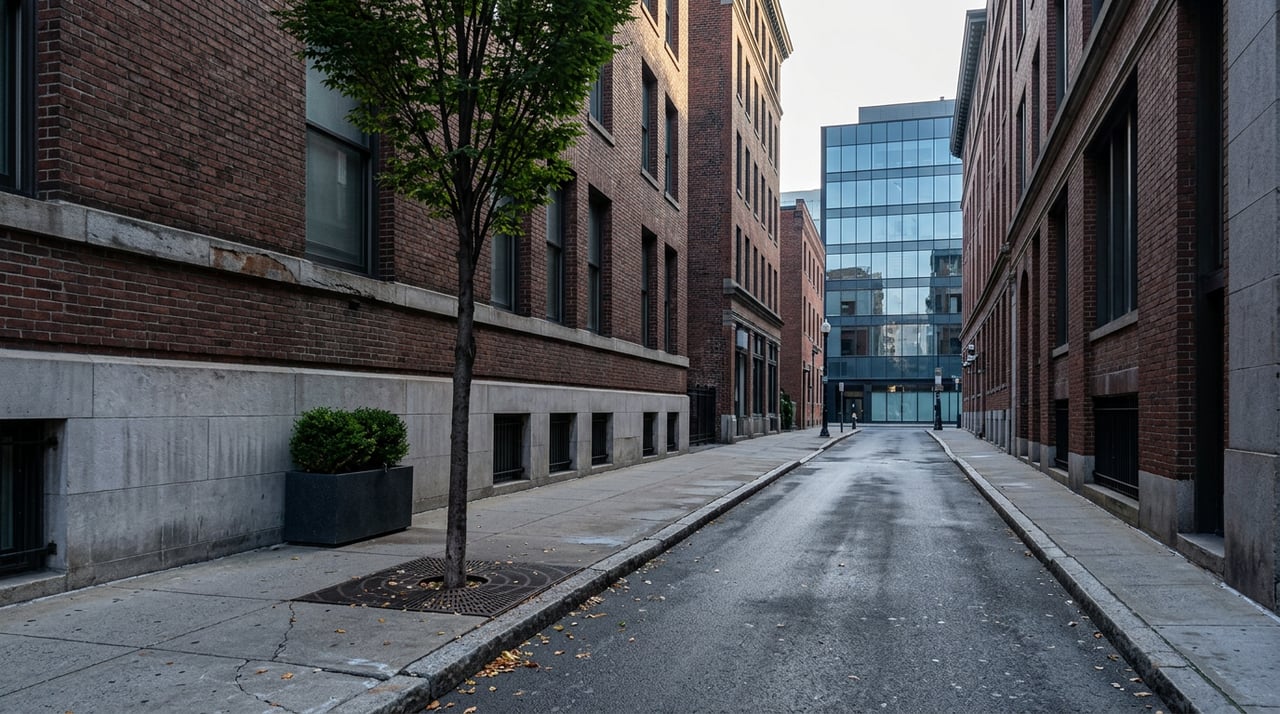
Walk down Devonshire Street at noon on a Tuesday and you will wait for a table. Walk down the same block at 8 PM on a Saturday and you might have the sidewalk to yourself. This is not a coincidence of scheduling. It is the entire operating logic of the Financial District, and it explains why some of the newest, best-funded restaurants in the neighborhood already feel like they are running on borrowed time, while a dive bar with skateboards nailed to the wall has been quietly doing fine for years.
If you live here, you already know the neighborhood empties out. What you may not have clocked is that the businesses filling in around you split cleanly into two categories: the ones built to catch the office crowd, and the ones that never tried to. Knowing which is which changes how you plan a Tuesday night versus a Saturday.
The Neighborhood Runs on Two Clocks
The clearest evidence of this split sits inside a single bar. The Fed, the British-inspired cocktail spot near Post Office Square, is packed with finance and banking workers Tuesday through Thursday and noticeably quieter once the weekend arrives, according to Fodor's coverage of downtown nightlife. High Street Place, the food hall a few blocks over, has been described the same way by regulars on Tripadvisor's Financial District forum: lively on work nights, thinner on Saturdays.
That is not a complaint about either place. It is a description of what they were built for. Both sit inside a district where the daytime population is driven by office towers, and both have found a way to make that daytime crowd profitable enough that the evening and weekend slowdown is a fact they can live with. The neighborhood's rhythm is not broken. It is just not the rhythm most restaurant reviews assume when they rate a place on ambiance without asking who it is open for.
Where the New Money Went
The clearest example of a business built entirely around the office clock is The Lineup, the food hall Michelin-starred chef John Fraser opened inside Winthrop Center's Connector space in January 2024. Boston.com described it plainly at the time: a food hall offering office workers another option for lunchtime sustenance, with five fast-casual concepts, including Neapolitan pizza at Gatto Pazzo and smash burgers at Big Grin, designed for people who want to elevate a lunch break, not linger over dinner. Two and a half years later, that description still holds. The Lineup remains a daytime destination first. Winthrop Center's residents-only brasserie, Winnie's, exists specifically because the tower's own developers understood that office-hour foot traffic and resident dinner service are two different businesses that happen to share a lobby.
Sando Table, which opened in the Financial District this past May according to Boston Magazine's dining roundup, followed the same logic from day one: a fast lunch spot built for the workday crowd rather than an evening destination.
Not every daytime bet pays off. Jamaica Mi Hungry, a Financial District spot built around the same office-lunch audience, closed this year, according to the closings tracked by Boston's Hidden Restaurants. The lesson is not that lunch-hour concepts fail. It is that even a captive audience of office workers is a narrower bet than it looks, because that audience disappears completely on weekends and takes its revenue with it. A restaurant that only works Monday through Friday, 11 to 2, needs those five hours to carry the whole week.
The Small Places That Never Bet on Office Workers
The businesses that shrug off the weekend slowdown are, almost without exception, older, smaller, and built around a specific local following rather than a tower's worth of daytime tenants.
Biddy Early's is the clearest case. In a WBUR piece on Boston nightlife spots that feel like an escape from the city, one local described it as sitting right in the middle of the Financial District's polish while feeling nothing like it, thanks to skateboards on the walls and a straightforward Irish-pub identity that has never chased the finance crowd's schedule. It is currently ranked among the neighborhood's top bars on Yelp, alongside The Fed and Bostonia Public House, which tells you it is not surviving on nostalgia. It is surviving because its customers do not evaporate on Friday at 6 PM.
Bar Cicchetti works the same way from a different angle. It is small, wine-focused, and has picked up James Beard recognition for its wine program under owner Haley Fortier, according to Fodor's. A wine bar that size cannot depend on office-tower volume. It depends on people who come back on purpose, which is a different kind of business than a food hall built to catch a lunch break between meetings.
The Chemist Cocktail Club, easy to miss because its signage is designed to look like a European pharmacy, and Amber Road round out the list of current, open Financial District spots that show up on the neighborhood's active bar and restaurant listings this year rather than its closures list. None of them are trying to be The Lineup. That is precisely why they are still here.
A Park That Keeps Office Hours
If you want the clock split in its purest form, look at Norman B. Leventhal Park in Post Office Square. It is a genuinely well-run 1.7-acre park, built above an underground garage, with a café, fountains, and a pergola around the central lawn, and it functions as a popular lunchtime destination for people who work in the surrounding towers.
The park runs a Midday Music series, sponsored by the Friends of Post Office Square, timed to the noon-to-2 PM lunch window, and free P.O. Fitness classes on the lawn during warmer months. Both are genuinely useful if you live nearby and want a reason to leave your desk or your apartment at lunchtime. But the park closes at 9 PM every night, and its programming is built entirely around the workday. It is not a park designed to be a Friday-night or Saturday-afternoon destination, because the organization that runs it built its calendar around the people who are already there at noon on a Tuesday, not the people who might wander over on a weekend.
That is not a criticism of the park. It is a useful piece of information if you are the kind of resident who assumes a beautiful green space in the middle of downtown should double as weekend gathering space. Here, it mostly does not, and knowing that in advance saves you a wasted walk.
What This Means If You Live Here
None of this means the Financial District goes dark once the office towers empty out. It means the neighborhood requires two different mental maps depending on the day and hour, and conflating them is how a resident ends up disappointed by a restaurant that was never trying to serve them in the first place.
For a weeknight, the office-hour businesses are worth leaning into precisely because that is when they are running at full capacity and staffing accordingly. The Lineup, Sando Table, and similar lunch-forward spots make sense as a fast weekday dinner grabbed on the way home, when the kitchen is still geared up for volume.
For a weekend evening, the smaller places that never built their business model around office workers are the better bet. Biddy Early's, Bar Cicchetti, and the Chemist Cocktail Club are not scaling down on Saturday because they were never scaled up around a five-day workweek to begin with.
The park works the opposite way from either of those. It is a lunchtime resource, full stop, and treating it as one rather than expecting evening programming saves you the trip.
Living downtown means learning which parts of your neighborhood are performing for a crowd that leaves at 6 and which parts were built with you, the person who stays, in mind. The Financial District has both. The trick is not mixing them up.
If you are thinking about buying, selling, or renting in the Financial District and want a read on which buildings and blocks fit the way you actually plan to live, Connect with our Downtown Boston team at Downtown Boston Realty. We know these blocks building by building, not just by their daytime foot traffic.